
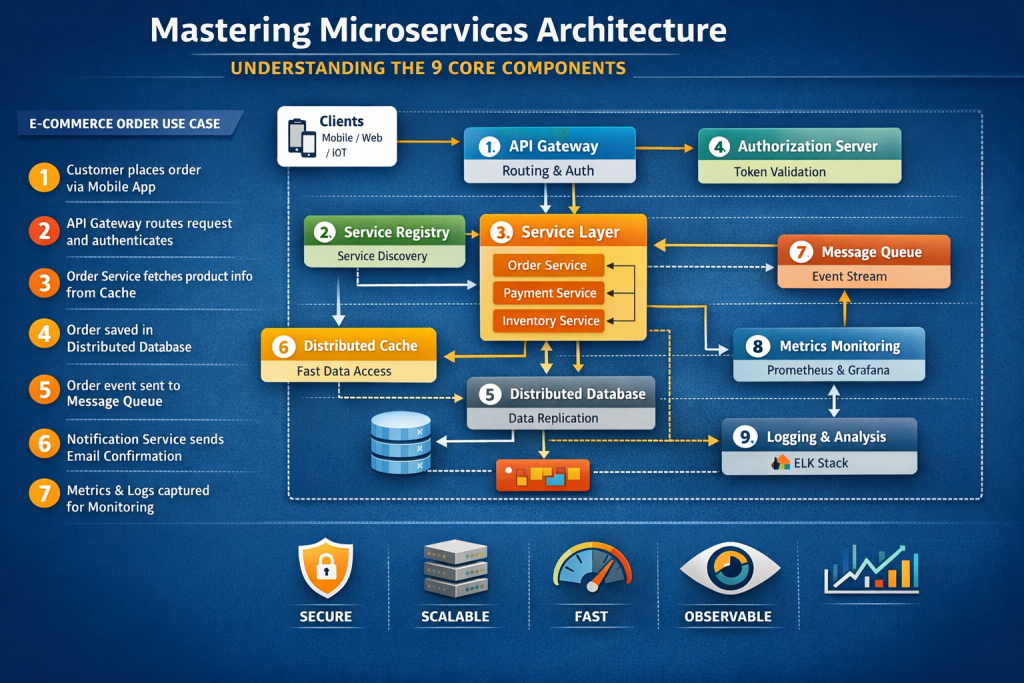
Mastering Microservices Architecture
Understanding the 9 Core Components of a Modern System
Modern software systems are no longer built as a single large application. Instead, they are designed as microservices—a collection of smaller, independent services that work together.
However, building microservices is not only about writing code. It requires an ecosystem of infrastructure components that manage communication, security, reliability, performance, and monitoring.
This document explains the 9 core architectural components of a microservices system using practical use cases and simple explanations.
1. API Gateway – The Entry Point
The API Gateway acts as the single entry point for all client requests.
Instead of clients calling different services directly, they send requests to the gateway, which then routes them to the correct microservice.
Key Responsibilities
- Request routing
- Rate limiting
- Authentication validation
- Load balancing
- Request transformation
Example Use Case
A mobile application needs data from:
- User Service
- Order Service
- Payment Service
Instead of calling three services separately, the mobile app sends a request to the API Gateway, which internally routes the request to the appropriate services.
Benefits
- Simplifies client interaction
- Improves security
- Centralizes traffic control
2. Service Registry – Dynamic Service Discovery
In microservices environments, services may scale up or down dynamically, meaning their network locations change frequently.
The Service Registry acts as a central directory of service locations.
How It Works
- Each service registers itself when it starts.
- Other services query the registry to locate the required service.
Example Use Case
- Service A needs to call Service B.
- Service A asks the Service Registry for Service B’s current address.
- The registry returns the active instance.
Popular Tools
- Eureka
- Consul
- Zookeeper
Benefits
- Enables dynamic scaling
- Simplifies service-to-service communication
3. Service Layer – Business Logic
The Service Layer contains the actual business logic of the application.
Each service is responsible for a specific domain function.
Examples of Microservices
- User Service
- Payment Service
- Order Service
- Notification Service
Each service:
- Runs independently
- Has its own deployment lifecycle
- Can scale individually
Example Use Case
An e-commerce platform may contain:
- Product Service
- Cart Service
- Order Service
- Payment Service
If the Payment Service fails, the rest of the system can still continue functioning.
Benefits
- Fault isolation
- Independent deployment
- Easier scalability
4. Authorization Server – Security Control
Security is critical in distributed systems.
The Authorization Server manages authentication and authorization using standardized protocols.
Common Protocols
- OAuth2
- OpenID Connect (OIDC)
- JWT Tokens
How It Works
- User logs into the system.
- Authorization Server issues a security token.
- Every request includes this token.
- Services validate the token before processing the request.
Example Use Case
An admin dashboard requires restricted access.
The Authorization Server ensures:
- Only authenticated users can log in
- Only authorized roles can access admin APIs
Benefits
- Centralized security management
- Strong authentication control
5. Distributed Data Layer – Data Replication
A distributed system must ensure data availability and fault tolerance.
The Distributed Data Layer handles data replication across multiple nodes.
Example
If one database node fails:
- Another replica immediately takes over.
Replication Strategies
- Master-Slave replication
- Multi-master replication
- Sharding
Example Use Case
A banking system cannot afford downtime.
If the primary database fails, the system automatically switches to a replica without interrupting users.
Benefits
- High availability
- Fault tolerance
- Data durability
6. Distributed Cache – Performance Optimization
Accessing databases repeatedly can slow down applications.
A Distributed Cache stores frequently accessed data in memory.
Popular Tools
- Redis
- Memcached
Example Use Case
An e-commerce product page is viewed thousands of times per minute.
Instead of querying the database each time:
- Product data is stored in cache
- Requests are served directly from memory
Benefits
- Reduces database load
- Improves response time
- Enhances user experience
7. Distributed Messaging – Asynchronous Communication
Microservices often communicate using message queues for asynchronous processing.
Instead of waiting for another service to respond, a service publishes a message to a queue.
Another service processes the message when ready.
Popular Tools
- Kafka
- RabbitMQ
- AWS SQS
Example Use Case
When a user registers:
- User Service saves the user.
- A message is sent to the queue.
- Email Service reads the message and sends a welcome email.
Benefits
- Decouples services
- Improves scalability
- Prevents service blocking
8. Metrics Monitoring – System Health
Monitoring ensures that the system is running efficiently.
Metrics tools collect performance data such as:
- CPU usage
- Request latency
- Error rates
- Throughput
Popular Tools
- Prometheus
- Grafana
Example Use Case
A sudden spike in response time triggers alerts in Grafana dashboards.
Engineers can quickly identify the affected service.
Benefits
- Performance visibility
- Real-time alerts
- Capacity planning
9. Centralized Logging – Troubleshooting
In microservices systems, logs are generated across many services.
Centralized logging collects and stores logs from all services in one place.
Popular Stack
ELK Stack:
- Elasticsearch
- Logstash
- Kibana
How It Works
- Services generate logs.
- Logstash collects logs.
- Elasticsearch indexes logs.
- Kibana provides visualization and search capabilities.
Example Use Case
A production error occurs.
Instead of checking logs on multiple servers, engineers search logs in Kibana to quickly locate the issue.
Benefits
- Faster debugging
- Unified log visibility
- Simplified troubleshooting
End-to-End Use Case Example
Consider a user placing an order in an e-commerce system.
- Client sends request → API Gateway
- Gateway authenticates request → Authorization Server
- Gateway routes request → Order Service
- Order Service discovers dependencies → Service Registry
- Order Service fetches product data → Cache
- Order saved → Distributed Database
- Order event published → Message Queue
- Notification Service sends email
- Metrics and logs recorded for monitoring
Key Benefits of This Architecture
| Feature | Benefit |
|---|---|
| API Gateway | Simplified client communication |
| Service Registry | Dynamic service discovery |
| Microservices | Independent scaling |
| Authorization Server | Centralized security |
| Distributed Data | High availability |
| Cache | Faster response times |
| Messaging | Loose coupling |
| Metrics | System health visibility |
| Logging | Faster debugging |
Conclusion
Microservices architecture shifts software development from a code-centric approach to a system-centric approach.
By integrating these nine essential components, organizations can build systems that are:
- Scalable
- Resilient
- Secure
- Highly observable
Mastering these components allows teams to design modern cloud-native applications capable of handling millions of users reliably.