
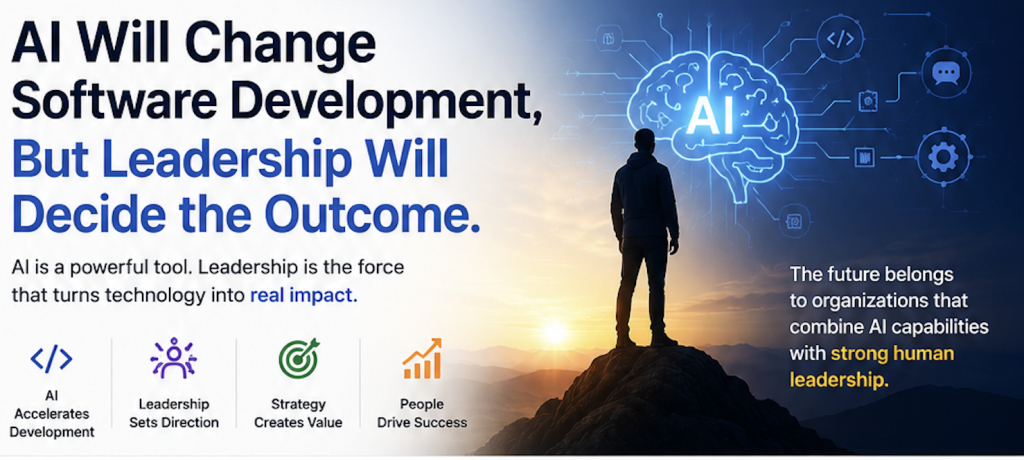
AI can generate code. Leaders generate vision.
Introduction
Artificial Intelligence is no longer a futuristic concept—it is transforming how we write code, design systems, test applications, review pull requests, generate documentation, and even analyze business requirements.
Tools like AI coding assistants, intelligent code review systems, automated testing platforms, and large language models are helping software teams work faster than ever before.
This technological shift has sparked an important question:
“Will AI replace software developers?”
The better question is:
“How should leaders use AI to build better engineering organizations?”
History teaches us that technology alone has never determined success. Whether it was electricity, the internet, cloud computing, or smartphones, organizations that combined innovation with strong leadership consistently outperformed those that simply adopted the latest technology.
AI is no different.
The future will not belong to the organizations using the most AI—it will belong to the organizations using AI with purpose, responsibility, and leadership.
Every Technology Revolution Needed Leadership
Throughout history, every major technological breakthrough followed the same pattern.
| Technology | Tool | Leadership Challenge |
|---|---|---|
| Industrial Revolution | Machines | Workforce transformation |
| Internet | Global connectivity | Business innovation |
| Cloud Computing | Elastic infrastructure | Digital transformation |
| Mobile Technology | Smartphones | Customer experience |
| Artificial Intelligence | Intelligent automation | Responsible adoption |
Technology creates possibilities.
Leadership determines outcomes.
AI Is a Multiplier, Not a Miracle
Imagine giving two organizations the exact same AI tools.
Organization A
- No clear objectives.
- No engineering standards.
- No governance.
- No review process.
- No training.
- Everyone uses AI differently.
Result
- Inconsistent code.
- Security concerns.
- Duplicate solutions.
- Technical debt.
- Confused developers.
Organization B
- Clear engineering standards.
- AI usage guidelines.
- Human review process.
- Architecture governance.
- Continuous learning.
- Measured productivity.
Result
- Higher quality software.
- Faster delivery.
- Better collaboration.
- Strong customer outcomes.
- Sustainable engineering growth.
Same AI. Different leadership. Different outcomes.
AI Can Write Code—But It Cannot Understand Purpose
AI can produce thousands of lines of code within minutes.
However, it cannot fully understand:
- Customer emotions.
- Business strategy.
- Organizational culture.
- Long-term product vision.
- Ethical considerations.
- Human relationships.
Consider building an online banking application.
An AI assistant can generate:
- Login screens.
- REST APIs.
- Database models.
- Unit tests.
- Documentation.
But only experienced people can answer questions like:
- Should this feature exist?
- Is customer data sufficiently protected?
- Does this align with business goals?
- What happens if this feature fails?
- How will users experience this change?
Technology answers “How?”
Leadership answers “Why?”
Leadership Gives AI Direction
Imagine AI as the world’s fastest race car.
Without a skilled driver:
- Speed becomes dangerous.
- Direction is uncertain.
- Small mistakes become major accidents.
Leadership is that driver.
AI provides acceleration.
Leadership provides:
- Vision.
- Direction.
- Priorities.
- Ethics.
- Accountability.
AI Should Enhance People, Not Replace Them
Some fear AI will eliminate software engineering jobs.
History suggests a different outcome.
When calculators became common, mathematicians didn’t disappear.
When spreadsheets arrived, accountants didn’t disappear.
When cloud computing emerged, system administrators didn’t disappear.
Instead, their roles evolved.
AI will transform software development in the same way.
Developers will spend less time writing repetitive code and more time:
- Solving business problems.
- Designing scalable architectures.
- Improving customer experiences.
- Collaborating across teams.
- Innovating faster.
The future belongs to professionals who learn to work with AI, not against it.
The Best Engineering Teams Treat AI as a Co-Pilot
Think about modern aviation.
Airplanes use advanced autopilot systems.
Yet every commercial flight still has trained pilots.
Why?
Because automation handles routine tasks.
Humans handle judgment, unexpected situations, ethics, and responsibility.
Software engineering should follow a similar philosophy.
AI should assist developers—not replace engineering judgment.
A practical engineering workflow might look like this:
Business Requirement
        ↓
Product Validation
        ↓
Architecture Review
        ↓
AI-Assisted Design
        ↓
AI Code Generation
        ↓
Developer Review
        ↓
Automated Testing
        ↓
Peer Review
        ↓
QA Validation
        ↓
Human Approval
        ↓
Production
This approach combines the speed of AI with the accountability of experienced professionals.
What Great Leaders Focus On
Leaders in the AI era should spend less time asking:
“How much code did AI generate?”
and more time asking:
- Did we solve the right problem?
- Did customer experience improve?
- Is our software secure?
- Did our team learn something new?
- Can we maintain this solution?
- Are we creating long-term value?
The quality of questions determines the quality of leadership.
A Story Worth Remembering
Two carpenters receive the same set of premium tools.
The first rushes to finish quickly.
The second measures carefully, plans thoroughly, and works patiently.
Months later, one house requires constant repairs.
The other becomes a place where generations live comfortably.
The tools were identical.
The craftsmanship was different.
AI is today’s powerful tool.
Leadership is the craftsmanship that turns potential into lasting value.
Five Principles for AI-Driven Leadership
1. Start with Purpose
Use AI to solve meaningful problems, not just to follow trends.
2. Keep Humans Accountable
AI can recommend.
People must decide.
3. Build a Learning Culture
Encourage experimentation while continuously sharing knowledge and lessons learned.
4. Create Clear Standards
Define how AI should be used, reviewed, and governed across the organization.
5. Never Stop Developing People
The greatest investment is still the growth of your team.
Technology changes rapidly.
Human potential continues to create the greatest competitive advantage.
Lessons for Everyone
Students
Learn AI, but also strengthen critical thinking, communication, and teamwork.
Software Developers
Use AI to automate repetitive tasks while focusing on design, quality, and problem-solving.
Managers
Create an environment where AI increases productivity without reducing collaboration or accountability.
Leaders
Remember that your responsibility is not just to adopt new technology but to help people succeed with it.
Final Thoughts
Artificial Intelligence is changing software development forever.
It will continue to write better code, automate more tasks, and accelerate innovation.
But technology alone has never built great companies.
People do.
Leadership does.
Culture does.
The organizations that thrive in the AI era will not be those with the most advanced tools—they will be those that combine intelligent technology with thoughtful leadership, continuous learning, strong engineering practices, and a commitment to developing people.
The future of software development is not AI versus humans.
It is AI empowered by human leadership.
Key Takeaways
- AI is a powerful accelerator, but leadership provides direction.
- Technology alone does not guarantee success.
- Human judgment, ethics, and accountability remain essential.
- The best teams combine AI speed with disciplined engineering practices.
- Great leaders invest in people, not just tools.
- Organizations succeed when innovation is guided by vision and responsibility.
“AI can write the code, but leadership writes the future.”
Bottom Quote:
“The future belongs to organizations that combine AI intelligence with human wisdom.”