
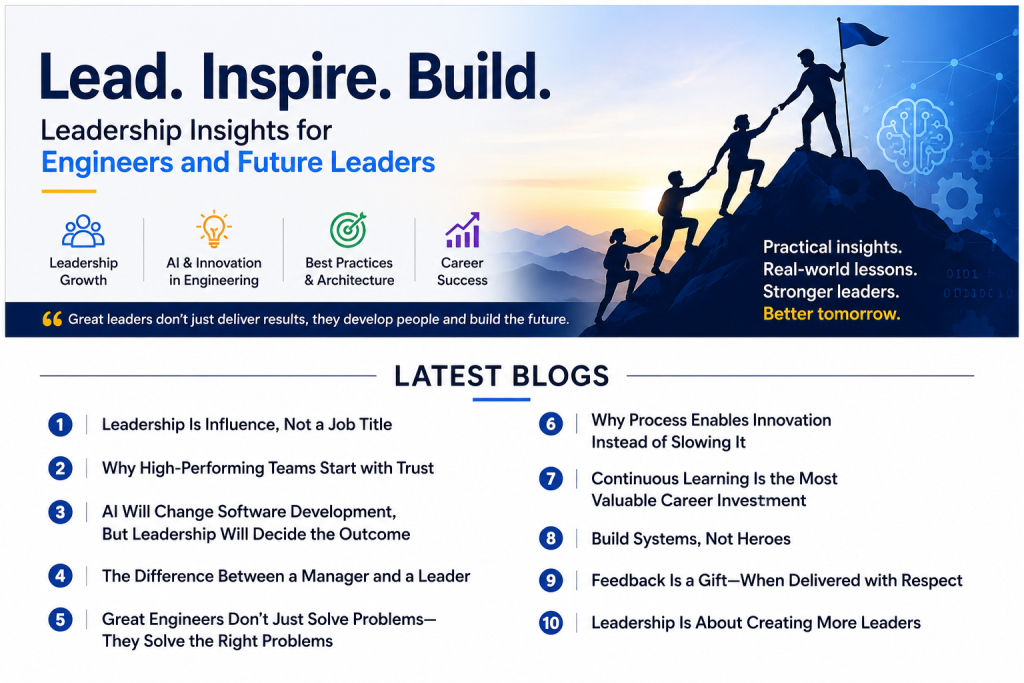
1. Leadership Is Influence, Not a Job Title
Introduction
Many people believe leadership begins when they receive the title of Team Lead, Manager, or Director.
In reality, leadership begins the moment people start trusting your decisions.
Titles may provide authority, but influence must be earned through consistent actions, integrity, and the ability to help others succeed.
What Great Leaders Do
Great leaders:
- Listen more than they speak.
- Remove obstacles for their teams.
- Make difficult decisions with transparency.
- Stay calm during uncertainty.
- Give credit to others.
- Accept responsibility when things go wrong.
Leadership is measured by the success of the people around you—not by personal achievements.
Key Takeaway
People follow titles temporarily. They follow leaders willingly.
2. Why High-Performing Teams Start with Trust
Technology evolves quickly, but trust remains the foundation of every successful engineering team.
Without trust:
- Engineers hesitate to share ideas.
- Mistakes are hidden.
- Innovation slows.
- Collaboration decreases.
With trust:
- Teams solve problems faster.
- Knowledge is shared freely.
- Feedback becomes constructive.
- Innovation accelerates.
Trust isn’t built through meetings; it’s built through consistent actions.
3. AI Will Change Software Development, But Leadership Will Decide the Outcome
Artificial Intelligence is transforming software development, but organizations often focus on tools instead of leadership.
AI can generate code in seconds.
Only leaders can ensure:
- Business alignment
- Quality standards
- Security
- Ethical decision-making
- Customer value
- Team growth
The future belongs to organizations that combine AI capabilities with strong engineering leadership.
4. The Difference Between a Manager and a Leader
Managers focus on execution.
Leaders focus on people.
Managers ask:
“Is the work complete?”
Leaders ask:
“Did the team grow while completing the work?”
Managers optimize productivity.
Leaders develop future leaders.
The best organizations need both.
5. Great Engineers Don’t Just Solve Problems—They Solve the Right Problems
Engineering excellence isn’t measured by how much code is written.
It’s measured by how many customer problems are solved.
Before writing code, ask:
- What business problem are we solving?
- Is there a simpler solution?
- Will customers benefit?
- Can we maintain this solution for years?
The best engineers spend more time understanding problems than implementing solutions.
6. Why Process Enables Innovation Instead of Slowing It
Many organizations believe process reduces speed.
Poor process does.
Good process improves speed by reducing confusion.
A mature engineering process provides:
- Clear ownership
- Better communication
- Higher quality
- Less rework
- Predictable delivery
Process should be lightweight, practical, and focused on delivering value—not creating unnecessary bureaucracy.
7. Continuous Learning Is the Most Valuable Career Investment
Technology changes every year.
The willingness to learn should never stop.
Successful leaders dedicate time each week to:
- Reading books.
- Studying architecture.
- Exploring AI.
- Learning from failures.
- Understanding business.
- Improving communication.
Knowledge compounds over time.
One hour of learning every day becomes hundreds of hours of growth over a year.
8. Build Systems, Not Heroes
Organizations often celebrate individuals who solve emergencies.
Great organizations build systems that prevent emergencies.
Instead of asking:
“Who can fix this?”
Ask:
“Why did this happen, and how can we prevent it?”
Great leaders reduce dependence on individuals by improving processes, documentation, automation, and knowledge sharing.
9. Feedback Is a Gift—When Delivered with Respect
Feedback should never be about criticism.
It should be about growth.
Effective feedback is:
- Timely.
- Specific.
- Respectful.
- Actionable.
- Balanced.
Leaders should recognize achievements publicly and discuss improvement opportunities privately.
Teams grow when feedback becomes part of everyday conversations.
10. Leadership Is About Creating More Leaders
One of the greatest measures of leadership is how many leaders you help develop.
Ask yourself:
- Who did I mentor this month?
- Who gained confidence because of my support?
- Who learned a new skill?
- Who became more independent?
Great leaders don’t create followers.
They create future leaders.
Final Thoughts
Leadership is a journey of continuous learning, self-reflection, and service. Technology, tools, and methodologies will continue to evolve, but the principles of effective leadership remain constant: build trust, communicate clearly, empower others, embrace innovation responsibly, and never stop learning.
Whether you are an individual contributor, a team lead, an engineering manager, or a senior executive, every interaction is an opportunity to lead by example. The organizations that thrive are those where leaders focus not only on delivering results but also on developing people and creating a culture of collaboration, accountability, and continuous improvement.
Remember: Success is not measured solely by what you accomplish, but by the positive impact you have on the people and teams around you. The best leaders inspire others to grow, innovate, and achieve more than they thought possible.