
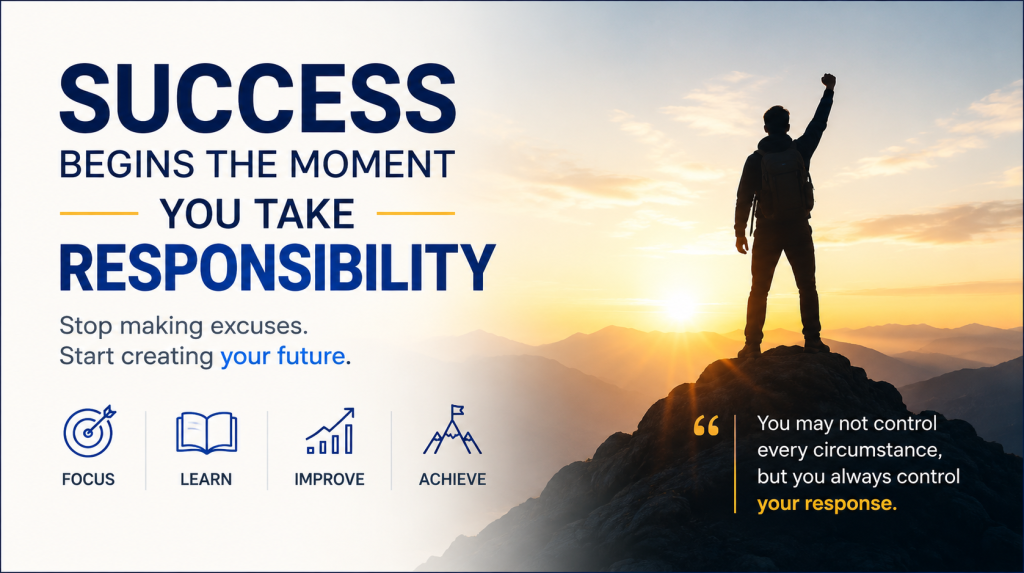
Success Begins the Moment You Take Responsibility
The day you stop making excuses is the day your growth truly begins.
Category: Leadership | Personal Development | Career Growth
Reading Time: 8–10 Minutes
Introduction
Every successful person has one thing in common—not extraordinary talent, unlimited resources, or perfect timing.
They choose to take responsibility.
Success doesn’t begin when you get your dream job, earn a promotion, start a business, or receive recognition. It begins the moment you decide that your future is your responsibility.
Many people spend years waiting for the right opportunity, the perfect manager, a better economy, or someone to notice their potential. While external factors can influence our journey, they should never define our destination.
The most powerful shift in life happens when we stop asking:
- “Why is this happening to me?”
and start asking:
- “What can I do to improve this situation?”
That single change in mindset transforms obstacles into opportunities and problems into lessons.
What Does Taking Responsibility Really Mean?
Taking responsibility doesn’t mean blaming yourself for everything that happens.
Instead, it means recognizing that while you can’t control every circumstance, you can always control your response.
It means saying:
- “I can learn.”
- “I can improve.”
- “I can adapt.”
- “I can prepare better.”
- “I can try again.”
Responsible people don’t wait for someone else to solve their problems—they become part of the solution.
The Difference Between Excuses and Responsibility
Consider two people facing the same challenge.
Person A
“I didn’t get promoted because my manager doesn’t support me.”
Person B
“I wasn’t promoted. I’ll seek feedback, improve my skills, increase my visibility, and prepare for the next opportunity.”
The circumstances may be identical.
The mindset is completely different.
The first person gives away their power.
The second person takes ownership of their growth.
Responsibility doesn’t guarantee immediate success, but it dramatically increases the likelihood of long-term success because it keeps you focused on what you can control.
The Circle of Control
One of the most valuable habits is learning to separate what you can control from what you cannot.
Things You Cannot Control
- Other people’s opinions.
- Economic conditions.
- Company policies.
- Past mistakes.
- Unexpected setbacks.
- Market competition.
Things You Can Control
- Your attitude.
- Your preparation.
- Your effort.
- Your learning.
- Your communication.
- Your integrity.
- Your discipline.
- Your response to challenges.
Successful people invest their energy where it has the greatest impact—on the things they can influence.
Responsibility Creates Opportunity
People often think opportunities appear first and responsibility comes later.
In reality, the opposite is true.
Employers, teachers, clients, and leaders naturally trust people who consistently demonstrate ownership.
When you become known as someone who:
- Delivers on commitments.
- Learns from mistakes.
- Solves problems.
- Supports others.
- Takes initiative.
You become someone others want to invest in.
Responsibility builds credibility, and credibility opens doors.
Lessons for Students
As a student, it’s easy to blame poor grades on difficult exams, challenging teachers, or lack of resources.
Instead, ask yourself:
- Did I prepare consistently?
- Did I ask questions when I was confused?
- Did I practice enough?
- Could I have managed my time better?
Every answer becomes an opportunity to improve.
Learning how to take responsibility early in life is one of the greatest advantages you can give yourself.
Lessons for Professionals
In the workplace, responsibility is often what separates average performers from future leaders.
Professionals who take ownership:
- Volunteer for meaningful work.
- Follow through on commitments.
- Admit mistakes honestly.
- Focus on solutions instead of blame.
- Continuously improve their skills.
These behaviors build trust and strengthen professional relationships.
Lessons for Managers and Leaders
Leadership is not about having all the answers.
It’s about creating an environment where accountability is shared, learning is encouraged, and people feel empowered to solve problems together.
Great leaders ask:
- “How can we improve?”
- “What did we learn?”
- “What can we do differently next time?”
They focus on progress rather than assigning blame.
Mistakes Are Teachers
Everyone makes mistakes.
The difference is what happens next.
Some people spend their energy defending their mistakes.
Others spend their energy learning from them.
Every mistake carries a lesson if we’re willing to reflect on it honestly.
Growth begins when we replace defensiveness with curiosity.
Practical Habits to Build Responsibility
Developing responsibility is a daily practice.
Here are simple habits that make a lasting difference:
- Own Your Actions
Accept both successes and mistakes without making excuses. - Keep Your Commitments
Reliability builds trust over time. - Seek Feedback
View constructive feedback as a tool for growth. - Focus on Solutions
When problems arise, ask, “What’s the next best step?” - Keep Learning
Every challenge is an opportunity to expand your knowledge. - Reflect Regularly
Spend a few minutes each week asking yourself what went well and what could be improved.
A Simple Daily Mindset
Instead of saying:
❌ “Why did this happen to me?”
Try asking:
✅ “What is this situation teaching me?”
Instead of saying:
❌ “Someone should fix this.”
Ask:
✅ “What can I do to help solve it?”
These small shifts in thinking build confidence, resilience, and leadership over time.
Final Thoughts
Life will never be completely fair or predictable. There will always be challenges beyond your control.
What defines your future is not the obstacles you face but the choices you make in response to them.
Every day presents an opportunity to learn, improve, and move one step closer to your goals.
Take responsibility for your learning, your attitude, your actions, and your growth.
When you do, success becomes less about luck and more about consistent progress.
Remember:
You may not control every circumstance, but you always control the person you choose to become.
Key Takeaways
- Responsibility is the foundation of personal and professional growth.
- Focus your energy on what you can control.
- Learn from mistakes instead of hiding them.
- Build trust by keeping your commitments.
- Growth begins when excuses end.
- Small daily actions create extraordinary long-term results.
The strongest people are not those who never face challenges—they are the ones who take responsibility for growing through them.